

Cricket: Hawke Cup tales
Thursday, Feb 12 2026
Ian Snook
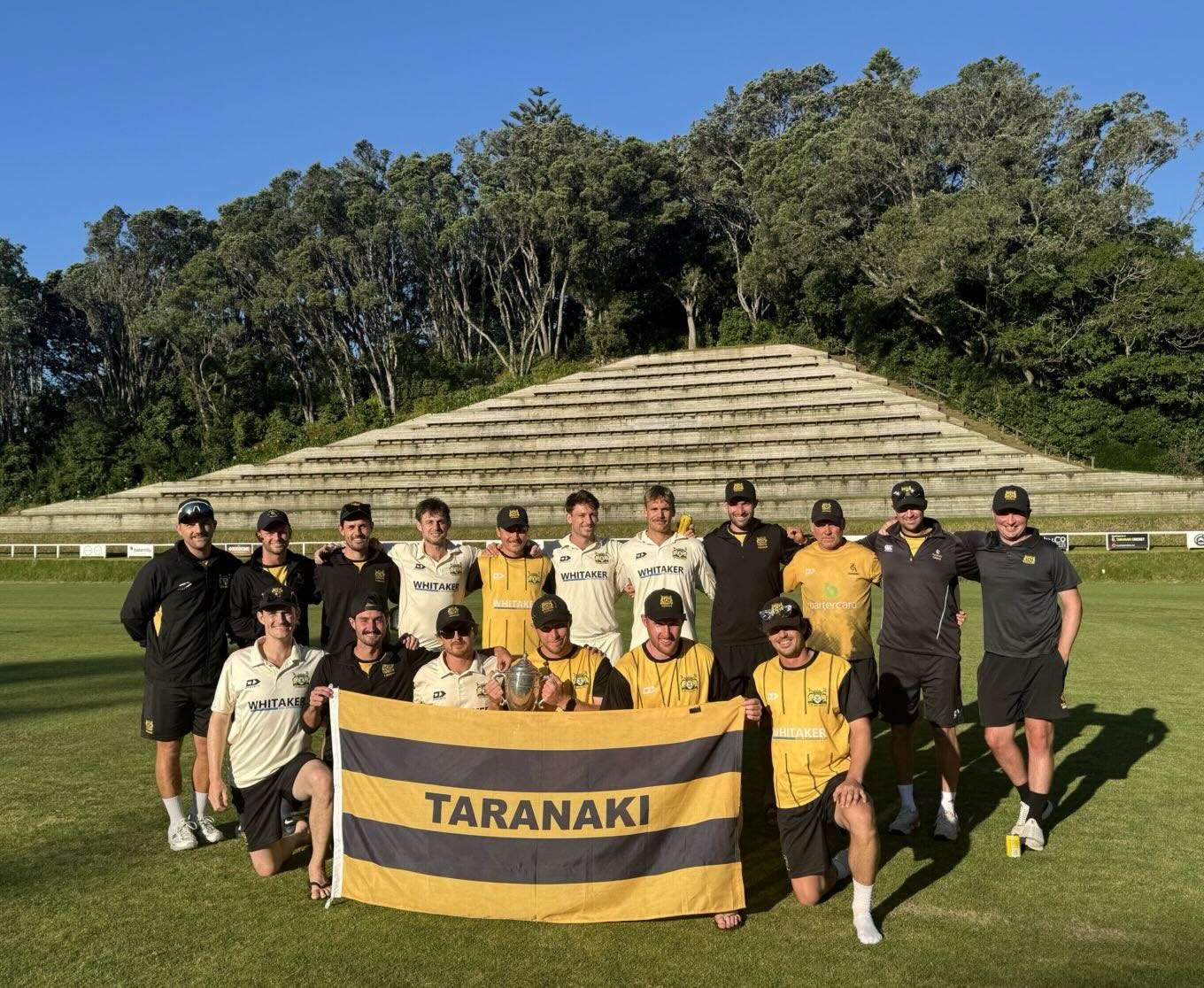
The Hawke Cup is in Taranaki.
It is a unique cup in that you only get one chance to win it in a season, and it can be won on the first innings.
If you hold it, every game is a must win. There is not a series of games. There is one game at a time.
This is surely the toughest form of the game, and it has been going since 1910
Every provincial cricketer in New Zealand has a goal to play in a Hawke Cup challenge. The goal then is to win it and retain it as long as possible.
The stories that emanate from Hawke Cup defences and challenges are legendary in provincial circles and they continue to be retold repeatedly, often getting more impressive as the years go by.
There is a special and unique flavour to Hawke Cup cricket. It is a one chance shoot out. Win it and it’s yours. Lose it and there are no other opportunities to play for it until you have gone through a whole season of games in your region the next year, which you must win to earn the challenge.
For some provinces, challenges may be years apart, or they may never occur again. But they’ll still be aiming to get there.
And if you do earn a challenge, you can win it on the first innings. That makes your every move crucial. There are no more games next week if you fail – it is all over. The pressure in these contests test every individual to his maximum.
The current Taranaki team are heading into their fifth defence. This is huge in the terms of provincial cricket.
Last season they defeated Hawkes Bay to lift the cup and have since beaten Hamilton, Canterbury Country, South Canterbury and Hawkes Bay to retain it.
These are the ‘big boys’ of New Zealand provincial cricket. Hamilton, Canterbury Country and Hawkes Bay have absolutely dominated the cup in the modern era since 2000.
Other provinces such as Otago Country, Marlborough, Bay of Plenty, Manawatu, Buller, North Otago Counties, Southland, Nelson, and Taranaki have had a taste, but it has never lasted very long.
Every player in those sides will remember their games though, and they will have a smile and a skip in their step when they discuss them, or a sad story to tell, explaining the loss.
Played over three days, as opposed to the normal two-day rep fixtures, these games require a physical and mental strength not often associated with cricket at this level.
With that, the growth of this current group from a band of boys who love cricket, into a group who take accountability of their actions, has been outstanding.
Their growth in producing concentrated performances has been so significant that the Hawkes Bay captain was quoted as saying, “They are a great team. They have been a great team for about 18 months. They’re the benchmark, and they have been since they took the Hawke Cup off us.”
It is too early in the piece to write up any current player who has legendary status in the Hawke Cup arena but there are a few already with great tales to tell.
Three left-handed batsmen left their mark against Hawkes Bay last week, with opener Josh Borrell cracking 130 runs, the diminutive Liam Muggeridge scoring a very polished 67, and the wristy and heady Trent McGrath adding a very pleasant 68 not out.
With Blackcap Will Young scoring a century as well, Hawkes Bay bowled a mammoth 157 overs and only captured four wickets. That is truly a Hawke Cup batting performance of note.
With the ball in hand, the freakish Ben Frewin took eight wickets and bowled nearly 30 overs. This is a feat matched by very few in the history of Hawke Cup cricket, and it was performed on a very unfriendly surface for bowlers.
The tough and determined skipper Jordan Gard bowled 38 overs. The physically small, but mentally large, Davis Mills, only went for 2.70 an over for 23 overs, and the spinning magician Liam Carr bowled 35 overs.
These are great stats. That’s what you want in a Hawke Cup game. Never let up and never doubt yourself.
The winning of these games often takes the full three days. That can be nearly 300 overs. That’s 1,800 balls and everyone of them requires a total effort and concentration.
The winning of the challenge in Napier last season was based around freakish Ben Frewin’s four wickets for 12 runs on the first morning.
Rupert Young scored 80 against Hamilton and Bailey Wisnewski set the team on its way with 66.
The Canterbury Country victory, the most exciting game I have been involved with in 70 years, was set up with Trent McGrath’s 80, and although he only got one wicket, it was the final wicket when CC still needed six runs, that Ryan Watson will never forget.
Big players stand up at the crucial times.
Liam Muggeridge hit a Hawke Cup century against South Canterbury, which is a feat not too many players can say they have achieved, and Young scored another 75.
Jordan Gard collected a bag of five wickets in that game which gave him 14 in the four games, just shy of Liam Carr’s 16 wickets.
More importantly every player contributed in their own way and in each of those games the fielding was outstanding.
Historically Taranaki have had the cup on six occasions.
In 1926 Taranaki defeated Whanganui where G Clarke bowled 47 overs and E Cole bowled 28. Both players were in their 40’s.
There were full mayoral welcomes at Hawera and New Plymouth upon their return.
They repelled three challenges against Hawkes Bay, Wairarapa and Poverty Bay before losing it to Whanganui.
In 1933 the team travelled by train and boat to Nelson where Stan Betts and Norm Giddy scored hundreds and they lifted the cup.
They kept it for three defences against Poverty Bay, Rangitikei and Southern Hawkes Bay before losing it to Manawatu.
With Manawatu nine down and still needing two runs Taranaki dropped a catch and Manawatu took a run. The last batsman then swung wildly at the next ball which dribbled not far away from the stumps and Manawatu had won.
It wasn’t until 1970 when Taranaki got their hands on the cup again, this time travelling to Invercargill and winning a low scoring game.
Dennis Yardley, one of the legendary Hawke Cup cricketers of the time, took 10 wickets in the match. Ian Snook was 12th man and upon request took beer out for drinks on the third day. It must have worked.
This group defended the cup an amazing 12 times, but not without a bit of luck, along with some remarkable individual performances.
This was the Yardley/ Jordan era. Dennis Yardley was the skipper, wicket taker and run maker. Ali Jordan was so dominant he would later be named in the NZ Hawke Cup team of the Century in 2011, the only Taranaki player named.
He took 9 wickets in one innings against Hutt Valley and bagged 14 against Franklin, 10 against Rangitikei and took a five for when a strong Hamilton side were bowled out for 101.
Trevor O’Byrne scored 150 not out batting at nine against Whanganui and Colin Barclay scored 106 against Hutt Valley batting at seven.
Barclay and Geoff Taylor put together a partnership of 185, with Taylor scoring 80.
There were many ill-tempered moments in many of these matches and in one game a Whanganui player was given out ‘hit the ball twice’ when he tapped it back to the fielder. No prisoners were taken in the 70’s.
Eventually Southland returned and took the cup back to the deep south.
The cup was difficult to win in those early days as home umpires were often a stumbling block for the challenging team.
In 1988 the cup returned when Taranaki defeated North Canterbury. (Now Canterbury Country)
Taranaki only managed 232 but a mammoth bowling spell of 39.5 overs, 14 maidens and 6-61 by the master, Jordan, saw North Canterbury bowled out for 213.
What made this spell even more impressive was that Jordan was bowling with an injury and was receiving treatment on the boundary between overs, from manager Peter Plumtree.
Legendary stories are plentiful in the Hawke Cup.
Northland then arrived with Lance and Chris Cairns along with a very strong side and immediately took the cup north, even after Brian Richards scored 93 in Taranaki’s 328.
It turned out to be at least 100 runs short.
Another very successful era started in 1994. This was the Glenn Sulzberger era.
Taranaki lifted the cup from Marlborough and repelled seven challenges which was significant with neutral umpires now in place.
Mark O’Niell and skipper Rodney Brown scored centuries against Hamilton.
Sulzberger scored 107 and 60 not out and took 6-90 against Waikato. Mathew Walker scored 108 against Canterbury Country, and in a game where Taranaki were well behind on the first innings against Manawatu, they won outright with 9 wickets down in their second innings.
This was truly ‘the Sulzberger game’.
He took 8-61, 6-88 and scored 112 not out in the second innings to take the team to victory. Not a bad effort.
Paul Hughes scored 104 against Northland before Central Otago lifted the cup in Taranaki’s eighth defence.
Taranaki well and truly beat Hamilton to lift the trophy in 2007, with Jamie Watkins scoring 126.
They then lost their first defence by one run.
Canterbury Country was 55 behind and eight down, but the Taranaki boys could not shut them out. Rumour has it that the last Canterbury Country batsman was out caught behind when they were two runs behind, but he was given not out. It didn’t help when he later admitted to hitting it.
Ouch. Just another Hawke Cup story.
And that brings us to the current group. They are working hard to embellish the history of the Hawke Cup in Taranaki.
Surely Hawke Cup cricket is the purest form of the game.
March 2007 Results
Taranaki defeated Hamilton.
Taranaki 370/25–0
Hamilton 290
J Watkins 126 / Watkins 3–60
Taranaki lost to Canterbury Country.
Taranaki 253 & 230
Canterbury Country 254 & 175–8
So close — a one-run first innings loss. Had them 8 down and 55 behind but couldn’t shut it out.
L Johnston 65 & T Stewart 55
D Bolstad 4–87
L Johnston 69 & D Robinson 52
A Mason 4–36
1993–1996 squad:
Rodney Brown ©, Russell Dempster, Mark Ebert, Ross Glover, Jason Holland, Tyler Kennedy, Denis Miheljevich, Mark O’Niell, Glenn Sulzberger, Warren Wisnewski, Brett Coombe, Paul Hughes, Peter Leach, Ian Patterson, Paul Plumtree ©, David Simpson, Matthew Walker, Peter O’Niell, Regan West
2007–2008 squad:
Matthew Broadmore ©, Keith Muller, Kolynn Tai, Aftab Habib, Leith Johnston, Travis Stewart, Jamie Watkins, David Good, Daniel Bolstad, Nick Taylor, Chris Cruikshank, Dean Robinson, Greg Paynter, Gavin Ewing, Andrew Mason