

Opinion: Super Rugby is losing its edge and something has to give
Tuesday, May 05 2026
Ian Snook
Photo by: John Velvin
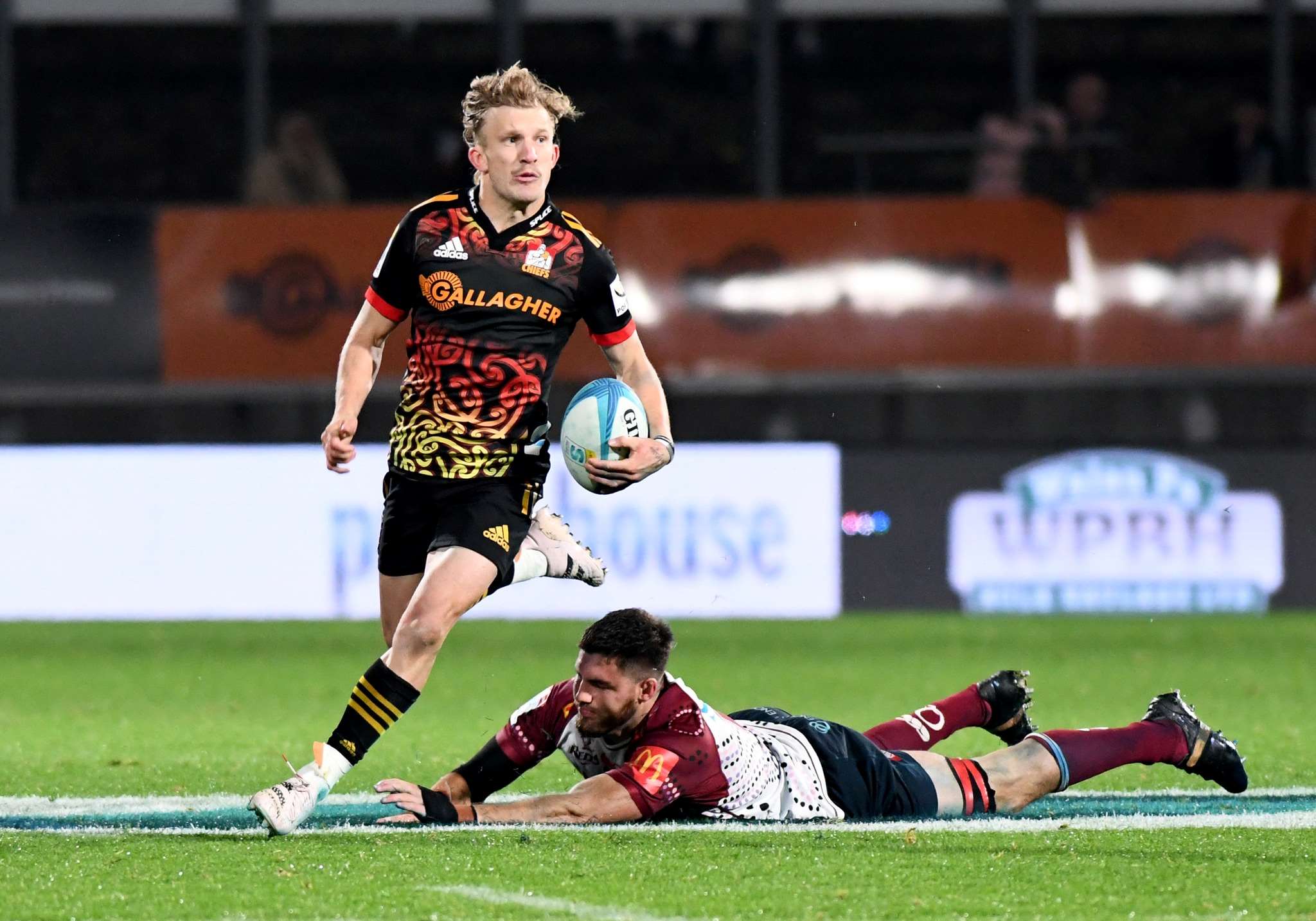
If you are a hard-core rugby fan, Super Rugby Pacific would have given you plenty to smile about watching the Super Round at Christchurch’s Te Kaha stadium under the roof.
The packed-out stadium for the games, played over three days, provided the energy and excitement of days long past.
Twenty years ago, if you didn’t get in early enough to secure your tickets, the Cake Tin would be sold out, and in Taranaki we were judged on having to produce a minimum crowd of 15,000 if we were to keep our seasonal Super Rugby game.
As entertaining as the Super Round was, with the NZ teams winning five-nil, and the Hurricanes in particular demonstrating that the ball doesn’t have to be carried by the first receiver time after time, I can’t imagine that the call for change is going to die away.
The former Taranaki player and current Hurricanes co-owner Malcolm Gillies suggested Super Rugby could die unless changes are made. Obviously, the income cannot meet the outgoings.
Graham Henry, the unsmiling former All Black coach, suggests Super Rugby is not serving its purpose. The inference being that it is not producing quality All Blacks.
Former All Black first-five Lima Sopoaga suggested a return to the NPC being the main competition, because he had a good experience when he played in that tournament.
Murray Mexted, the former All Black loose forward and rugby entrepreneur, stated Super Rugby has killed club rugby. Yep, professionalism has not been great for the amateur game.
The list goes on.
It is unlikely that Super Rugby in its present format will be put to bed because this is the best that can be managed.
South Africa have long left our shores and are thriving. Their Currie Cup may not have the grunt of old but by competing in the European Champions Cup and European Challenge Cup, with the Currie Cup providing the development route, they are able to churn out a huge number of quality players.
They also crucially select players who are not suiting up in South African provincial kit.
Argentina and Japan, under the monikers of Jaguares and the Sunwolves, had five seasons each from 2016, but financial unsustainability and covid put a halt to their participation.
In 2022 the Fijian Drua and Moana Pasifika were included. In theory this is the best format for our region as Australia and New Zealand support and promote the players within our geographical region, and these players have a history in the game in these countries.
NZR need to make the current format viable.
The questions that need to be answered are how the game becomes a better spectacle, how does the playing standard lift, and how is the financial sustainability managed.
There are a lot of moving parts which need to come together.
The better spectacle aspect lies with the coaches and referees.
It was interesting to hear Leicester Fainga’anuku say at the conclusion of the Crusaders versus Waratahs game, that ‘once New Zealand coaches lead the way with innovation and were in front of the pack.’
He had just completed 80 minutes on the flank and was buzzing. I have no doubt the implication was that coaching in NZ has tred the path of uniformity and coaches were lacking the confidence to create their own game plan or be truly innovative.
The fear of losing has imposed itself on the coaches and players.
Worth a shout though are the Hurricanes, with two NPBHS first-fives Jason Holland and Brad Cooper in the coaching team, and co-captains from FDMC Jordy Barrett and du Plessis Karifi, playing a fast and furious game with plenty of first-phase attacks, and not relying on the first ball carrier to set up the next phase time after time.
The coaches are responsible for entertaining. It’s a tough one but when the best players in the country are under their wings, it is not impossible.
Tony Brown is not the only imaginative coach from NZ; it is time to free up all those others.
Refereeing in Super Rugby has become so concentrated on leniency that we are not preparing our players for international rugby and the infringements that are waved on are frustrating for the true rugby watcher.
There is an emphasis on try scoring over the contest for the ball.
According to AI, rugby is a game about continuous play, spatial management and a physical contest for possession. You can’t argue with that.
So why are referees taking the contest out of the game? It is almost impossible for the defensive team to win the ball as the attack goes off their feet, seals the ball off, pods flop all over the ball, halfbacks can roll the ball back in a scrum and ruck, players enter from the side, players play the ball on the ground, and so it goes on.
Halfbacks put the ball in crooked and are babysat throughout the game and the refs are now babysitting the fullbacks as well.
Teams can still play an entertaining game if the laws are refereed correctly.
They will certainly be refereed differently by non-Super rugby nations.
Finally, the best solution for lifting playing standards, creating opportunities and ensuring financial sustainability is to follow South Africa’s lead and let players take up contracts overseas.
There doesn’t need to be restrictions on who can go, any player who feels the time is right should be able to head offshore and still be available for the All Blacks.
There are sufficient coaches and personnel at NZR, and New Zealanders coaching overseas, to keep a close eye on performances, no matter where the residence. Adding a couple of selectors would be easy enough.
It may make selection a little trickier for those players but as it is now it can be hard for a player to earn a position if he is not in the cycle at the beginning of the four years of a World Cup rotation.
This concept would provide players with growth opportunities and free up a whole heap of money which can be spent on those staying in NZ.
It would then provide opportunities for more players to compete at Super Rugby level, rather than having them stuck in the NPC. This could accommodate possibly thirty players who can also line-up in the NPC following Super Rugby completion.
In fact, that number might be doubled. Sky TV listed a team of current Super players who are going overseas at the end of this season.
Reuben O’Neill, Kurt Ekland, Pouri Rakete-Stones, Samipeni Finau, Isaia Walker-Leawere, Devan Flanders, Dalton Papali’i, Hoskins Sotutu, Xavier Roe, Stephen Perofeta, Fehi Fineanganofo, David Havili, Braydon Ennor, Sevu Reece and Etene Nanai-Seturo.
There are a couple there who could wear an All Black jersey in 2026.
While the best players are toughing it out in England and France or are refreshing in Japan, there are spots for more players at a higher level at home.
With the clubs overseas paying the salaries of our best players there will be a bigger pot in NZ to deal with the players at Super level.
As well, it opens opportunities for more players at home.
If we want to be in the fight for number one ranking, NZR cannot do what they are currently doing. It will be interesting to see what direction they take.
Ian Snook is a former Central Districts and Taranaki cricket captain, representative rugby player, coach, administrator and longtime sports columnist.